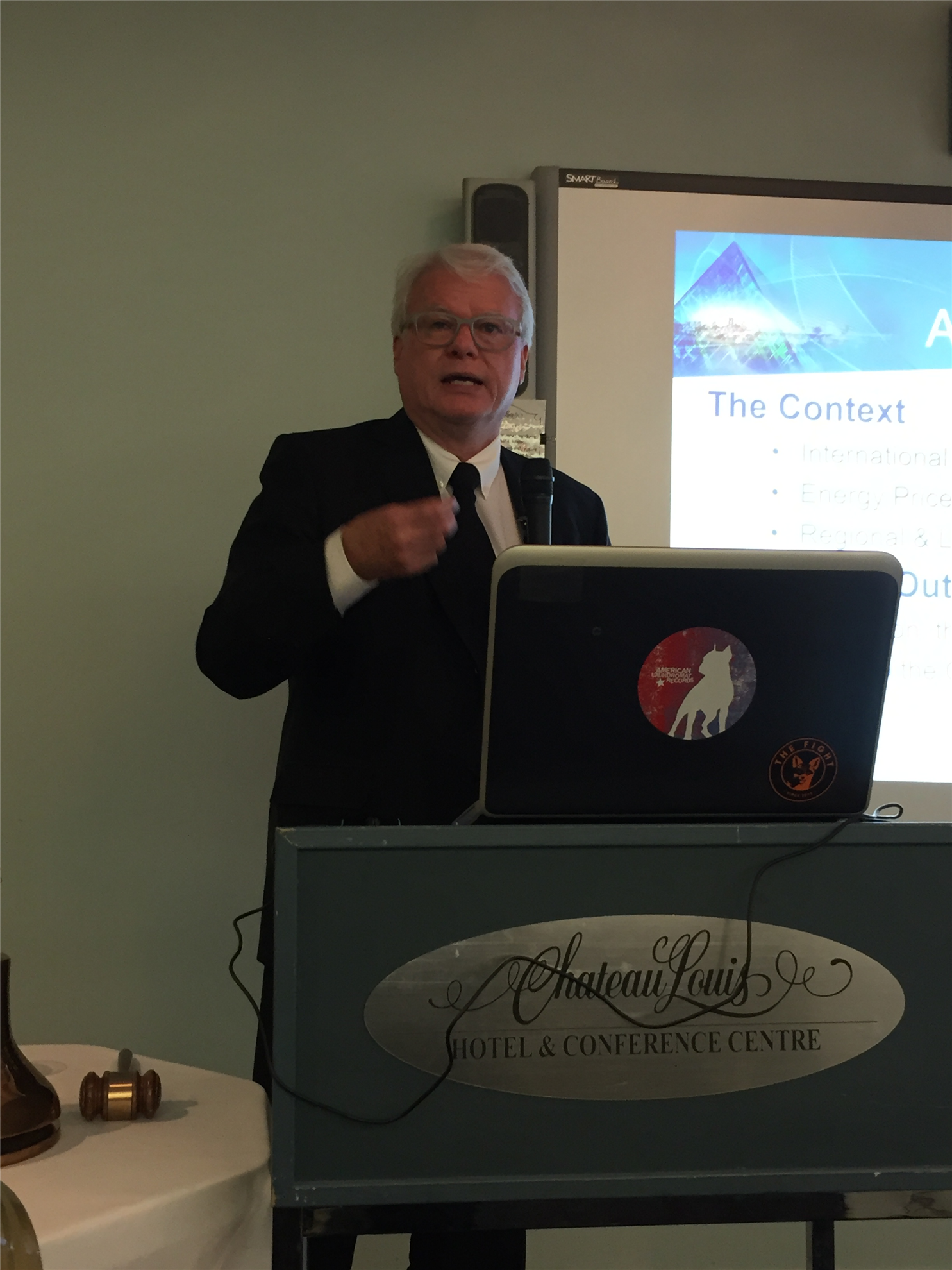
 Guest Speaker: Joe Lizotte introduced John Rose, for the third time over the last few years, to give us an upbeat opinion of the state of the city, the province and Canada. Some positive light will shine on Edmonton in the coming year. The long term outlook shows global improvement in China 6%, emerging nations 5%. For 2018 the world will improve by 3.5%; the USA by 2.5%; Canada by 2%; the Euro market by 1.75% . The global markets are still fragile. Re Alberta and Edmonton we depend on the market price of West Texas Intermediate Oil which had 5 to 10 year lows in 2016. 2017 is up a little, now around US$45. Companies can make profits around US$50 per barrel but even at the price level of $55 to $60, there will be no significant investments occurring. Thus the price has to exceed US$60 to get Nisku manufacturing going strong. Alberta's production oil is Western Canada Select which is a little heavier than West Texas Intermediate but there is not a significant difference. There will be a downturn in the Alberta economy because the oil price is remaining low. The Kinder Morgan pipeline will help improve the gross domestic product of the province by 0.2% when it is approved. Natural gas pricing is also depressed but has an improved scenario as the USA replaces coal fired plants by natural gas plants. There is also a big move of natural gas product from USA to Mexico. LNG (liquified natural gas) is being exported from the USA eastern coast which will mean problems for B C but good for Alberta by increasing the market price. Edmonton continues to out perform all of Alberta even though there is still a downturn in manufacturing. Canadian manufacturing is up 1%. Re unemployment: Calgary is up to 10%, Edmonton is 7%, Alberta is at 8.5%. There were massive job losses in 2015 and 2016. Edmonton's employment has increased over the last year but moves from rest of Alberta and from the rest of the world mean that our unemployment rate remains high. Job growth is good in Edmonton but the rest of Alberta has a lot slower recovery. Alberta is down 46,000 jobs, mainly in energy, construction and manufacturing. Education and healthcare in Edmonton have shown increases. Finance, insurance and real estate are also up in Edmonton. The losses are in manufacturing, energy and other services including professional services. Lethbridge and Medicine Hat show growth up 1.75% but their economies don't have significant oil and gas exposure. Calgary's employment turned around recently and is up higher than 2014. The rest of Alberta has very poor results (Grande Prairie has taken a mega hit). In Red Deer 1 in 10 jobs disappeared. Inflation is down because housing costs have come down but that is starting to reverse. Inflation will be back to 2.5% in the short term because of minimum wage increases and carbon tax levies. Downside of the Alberta economy: weakness caused by low oil prices and a major downturn in large construction projects. The upside is USA tax cuts plus the fact that there is only a partial recovery in USA oil production. In addition the cuts by OPEC have been enforced and there has been price recovery. Emerging markets like Brazil and Asia are doing well. John was thanked by Ingrid Neitsch. Notice: There are no meetings on May 22 and May 29. The change over meeting scheduled for June 1 has been postponed to the June 5 luncheon meeting at the University of Alberta Faculty Club.
|